How Public Access to Freedom Information Laws Transforms Democracy

The right to know is not a privilege—it is the bedrock of an informed society. When governments withhold information, citizens lose their ability to scrutinize decisions, challenge abuses, and hold power accountable. Yet, across the globe, freedom information laws access public systems remain fragmented, often obscured by bureaucratic red tape or legal ambiguity. The gap between theoretical transparency and practical reality exposes a critical vulnerability in modern governance.
These laws—whether framed as Freedom of Information (FOI) acts, public records statutes, or constitutional guarantees—exist to dismantle opacity. They compel institutions to release data unless disclosure would harm legitimate interests. But their effectiveness hinges on three pillars: strong legal frameworks, public awareness, and enforceable mechanisms. Without all three, even the most progressive legislation risks becoming a hollow promise.
The stakes could not be higher. From investigative journalism exposing corruption to activists tracking human rights violations, unrestricted access to public information is the difference between a functioning democracy and one where power operates in the shadows. Yet, navigating these laws demands more than good intentions—it requires understanding their origins, mechanics, and the battles still being fought to expand their reach.
The Complete Overview of Freedom Information Laws and Public Access
At its core, freedom information laws access public refers to the legal frameworks designed to ensure citizens, journalists, and organizations can request and obtain government-held data. These laws vary widely—some countries mandate proactive disclosure (e.g., Sweden’s Offentlighetsprincipen), while others rely on reactive requests (e.g., the U.S. Freedom of Information Act). The underlying principle remains consistent: transparency fosters trust, and trust is the currency of democratic legitimacy.The challenge lies in implementation. Many jurisdictions face systemic barriers: vague exemptions, excessive fees, or deliberate delays that effectively deny access. For example, a 2023 study by the Center for Public Integrity found that 60% of FOI requests in the U.S. were either denied or required costly litigation to resolve. Meanwhile, in authoritarian regimes, these laws exist in name only, with enforcement mechanisms gutted or ignored. The result? A global patchwork where public access to information is either a robust tool or a mere illusion.
Historical Background and Evolution
The modern push for freedom information laws access public traces back to the 18th century, when Enlightenment thinkers like John Stuart Mill argued that sunlight was the best disinfectant for government malfeasance. The first formal FOI law emerged in Sweden in 1766, followed by Finland in 1951—a reflection of Nordic traditions valuing civic engagement. However, it was the U.S. that codified the principle in 1966 with the Freedom of Information Act (FOIA), a response to Cold War-era secrecy and public demand for accountability.The 20th century saw a proliferation of similar laws worldwide, often tied to anti-corruption movements or post-authoritarian transitions. South Africa’s 1996 Promotion of Access to Information Act was a cornerstone of its democratic reconstruction, while the EU’s 2019 Access to Documents Regulation standardized transparency across member states. Yet, progress remains uneven. In 2020, the UN Special Rapporteur on Freedom of Opinion and Expression noted that nearly half of all countries lacked adequate FOI legislation, leaving billions in the dark.
Table of Contents
- The Complete Overview of Freedom Information Laws and Public Access
- Historical Background and Evolution
- Core Mechanisms: How It Works
- Key Benefits and Crucial Impact
- Major Advantages
- Comparative Analysis
- Future Trends and Innovations
- Conclusion
- Comprehensive FAQs
- Q: Can I request information from any government agency under FOI laws?
- Q: How long does it take to get a response to an FOI request?
- Q: What if my FOI request is denied? Can I appeal?
- Q: Are there fees for making FOI requests?
- Q: How can I use FOI laws to investigate corruption?
- Q: What’s the difference between FOI laws and open data portals?
- Q: Can corporations or private entities be forced to disclose information under FOI laws?
- Q: What’s the most effective way to ensure FOI laws are enforced?
The evolution of these laws mirrors broader shifts in technology and governance. Digital archives, open data initiatives, and real-time request portals have transformed public information access from a bureaucratic slog into a near-instant process—in theory. In practice, resistance persists. Governments often classify information as "national security" or "commercial confidentiality," while corporations lobby to shield proprietary data under "trade secret" exemptions. The battle for freedom information laws access public is as much about legal text as it is about political will.
Core Mechanisms: How It Works
Most freedom information laws access public systems operate under a request-response model, where individuals submit inquiries to government bodies, which then assess whether disclosure is permissible. The process typically involves:1. Filing a Request: Specifying the records sought, often with minimal detail (e.g., "all emails between Agency X and Company Y").
2. Initial Review: The institution determines if the request falls under exemptions (e.g., personal privacy, law enforcement investigations).
3. Disclosure or Appeal: If granted, records are released; if denied, the requester can appeal or sue.
Key variations exist. Some countries (e.g., Norway) require proactive publication of certain datasets, while others (e.g., Russia) impose pre-publication censorship. Fees for requests range from nominal (€5 in Sweden) to prohibitive (up to $275 per hour in the U.S. for FOIA appeals). These costs create a digital divide in information access, disproportionately affecting marginalized communities.
Technology has also introduced new mechanisms. Open data portals (e.g., data.gov.uk) provide pre-curated datasets, reducing the need for individual requests. However, critics argue these portals often exclude sensitive or politically contentious information. Meanwhile, automated FOI tools (like FOIA Machine in the U.S.) use AI to track request statuses, but their reliance on government cooperation remains a weak point. The core tension persists: freedom information laws access public must balance openness with the need to protect legitimate interests—a delicate equilibrium rarely achieved.
Key Benefits and Crucial Impact
The primary justification for freedom information laws access public is simple: transparency reduces corruption, improves decision-making, and empowers citizens. When institutions operate in the light, they are less likely to engage in nepotism, fraud, or human rights abuses. Studies show that countries with strong FOI laws experience lower levels of graft—Transparency International estimates that open governance can cut corruption by up to 30%. Beyond ethics, these laws drive innovation. Silicon Valley’s rise was fueled by public-funded research data; today, open science initiatives rely on similar principles.Yet, the impact extends beyond economics. Public access to information is a safeguard for democracy itself. During the Arab Spring, FOI requests exposed government abuses, fueling protests. In India, the Right to Information Act (2005) enabled citizens to challenge everything from school meal theft to police brutality. The data proves the point: where freedom information laws access public are enforced, civic engagement surges. A 2022 Reuters Institute report found that 78% of journalists in high-transparency countries cited FOI laws as essential to their work—a testament to their role in holding power accountable.
> "Secrecy is the ally of tyranny; transparency is the handmaiden of liberty." — Thomas Jefferson, advocate for open governance
Major Advantages
- Accountability: FOI laws force institutions to justify decisions, reducing arbitrary power. For example, the Panama Papers leak relied on leaked but legally obtained documents to expose global tax evasion.
- Informed Citizenship: Voters can evaluate policies based on full facts. In the U.S., FOIA requests revealed the CIA’s torture program, shaping public debate on national security.
- Economic Efficiency: Open data reduces redundant spending. The UK’s Government Data Service saved £1.7 billion annually by sharing datasets across agencies.
- Journalistic Investigations: Without FOI, stories like the Watergate scandal or Cambridge Analytica’s data misuse might never have seen the light of day.
- Human Rights Protections: FOI requests have uncovered mass graves, extrajudicial killings, and environmental disasters (e.g., Flint, Michigan’s lead crisis).
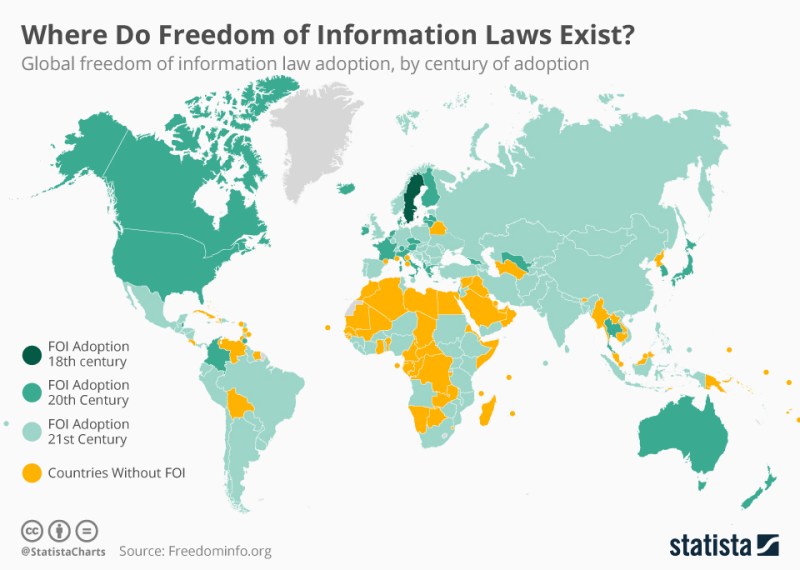
Comparative Analysis
| Country/Region | Strengths and Weaknesses of Public Access Laws |
|---|---|
| United States (FOIA) |
Strengths: Broad scope, judicial oversight. Weaknesses: Vague exemptions (e.g., "deliberative process"), high appeal costs, backlogs (some requests take years). |
| European Union (Access to Documents Regulation) |
Strengths: Harmonized across member states, strong privacy protections. Weaknesses: Complex exemptions for "commercial interests," slow processing in some countries. |
| India (RTI Act) |
Strengths: Low-cost requests, proactive disclosure in some sectors. Weaknesses: Harassment of requesters, weak penalties for non-compliance. |
| China (Government Information Disclosure Regulation) |
Strengths: Expanding scope under Xi Jinping’s reforms. Weaknesses: Heavy censorship, requests often denied on "state secrets" grounds. |
Future Trends and Innovations
The next decade will test whether freedom information laws access public can adapt to digital transformation. Blockchain-based transparency (e.g., Estonia’s e-residency model) could create tamper-proof records, but adoption hinges on overcoming privacy concerns. Meanwhile, AI-assisted FOI tools may streamline requests, though they risk reinforcing biases if trained on incomplete datasets. The bigger challenge lies in global standardization. Efforts like the Open Government Partnership aim to harmonize laws, but resistance from authoritarian regimes and corporate lobbyists threatens progress.Another frontier is environmental and health data. As climate change accelerates, FOI requests are increasingly used to challenge corporate greenwashing or expose pollution (e.g., Exxon’s climate deception). Similarly, the COVID-19 pandemic exposed gaps in pandemic data transparency—lessons that will likely spur reforms. The future of public information access will depend on whether societies prioritize collective knowledge over institutional secrecy. The tools exist; the political will remains the limiting factor.

Conclusion
Freedom information laws access public is not just about paperwork—it’s about power. The ability to demand and receive information is a democratic non-negotiable, yet its potential is often undermined by design. From the FOIA’s birth during the Cold War to today’s battles over algorithmic transparency, the struggle for open governance is ongoing. The data is clear: where these laws are strong, societies thrive. Where they are weak, corruption and abuse flourish.The path forward requires three things: legal reforms to close loopholes, technological innovation to reduce barriers, and public pressure to demand accountability. The tools are within reach. The question is whether the world will choose transparency—or continue to operate in the dark.
Comprehensive FAQs
Q: Can I request information from any government agency under FOI laws?
Not always. Exemptions vary by country but often include national security, law enforcement investigations, trade secrets, and personal privacy. For example, the U.S. FOIA excludes the CIA’s covert operations and FBI’s ongoing cases. Always check your jurisdiction’s specific exemptions before requesting sensitive data.
Q: How long does it take to get a response to an FOI request?
Deadlines differ globally. The EU requires responses within 15 business days, while the U.S. FOIA allows 20 days (extendable to 10 more). Delays are common—some requests take years due to backlogs or legal challenges. Proactive requesters use FOI trackers (e.g., FOIA Machine) to monitor statuses.
Q: What if my FOI request is denied? Can I appeal?
Yes, but the process varies. In the U.S., denials can be appealed to the agency or sued in federal court. The EU allows appeals to national oversight bodies. Some countries (e.g., India) permit third-party interventions to support requesters. Persistence is key—many high-profile cases (e.g., WikiLeaks’ Afghan War logs) started as denied requests.
Q: Are there fees for making FOI requests?
Fees exist but should not be prohibitive. The EU caps charges at €50 for simple requests, while the U.S. allows agencies to charge $0.10 per page (with waivers for low-income requesters). Some countries (e.g., Sweden) offer free access to basic data. Always ask about fee exemptions—many organizations provide pro bono assistance.
Q: How can I use FOI laws to investigate corruption?
Start with targeted requests. Focus on contracts, emails, and financial disclosures—these often reveal conflicts of interest. For example, journalists used FOIA to expose Halliburton’s no-bid Iraq contracts. Build alliances with watchdog groups (e.g., Sunlight Foundation) and legal aid organizations to strengthen your case. Document denials or delays—they may indicate systemic issues.
Q: What’s the difference between FOI laws and open data portals?
FOI laws require reactive disclosure (you ask, they respond), while open data portals provide proactive publication of pre-selected datasets. Portals are faster but may exclude sensitive information. For instance, data.gov.uk offers spending data but lacks details on individual grant allocations. Use both: FOI for hidden records, portals for structured data.
Q: Can corporations or private entities be forced to disclose information under FOI laws?
Generally, no. FOI laws apply to government-held records, not private companies—unless they’re acting as government contractors (e.g., Blackwater’s FOIA-exempt status). However, some countries (e.g., Norway) have sector-specific transparency laws for utilities or healthcare providers. For private data, consider competition laws (e.g., GDPR) or whistleblower protections.
Q: What’s the most effective way to ensure FOI laws are enforced?
Combine legal action, public pressure, and technological tools. File requests strategically (e.g., during Sunlight Week in the U.S.), sue when necessary, and publish denials to shame institutions. Advocate for FOI ombudsmen (independent overseers) and automated transparency tools. History shows that collective action—not just laws—drives real change.
Leave a Comment
Comments are moderated before appearing. The data you submit is processed according to the Privacy Policy of Neip.