The Smart Investor’s Guide to What Is Roth 401k

Tax laws shape retirement strategies more than most investors realize. While traditional 401(k)s have dominated employer-sponsored plans for decades, the Roth 401(k) has emerged as a game-changer—especially for high earners and those anticipating higher taxes in retirement. Unlike its pre-tax counterpart, this account lets you contribute after-tax dollars, offering potential tax-free growth and withdrawals. But its rules are nuanced, and misunderstanding them can cost you in penalties or missed opportunities.
The Roth 401(k) isn’t just a variation—it’s a strategic tool that flips the script on retirement tax planning. By paying taxes upfront, you eliminate future tax liabilities on withdrawals, provided you meet the IRS’s age and holding-period requirements. This structure appeals to younger professionals, freelancers, and anyone expecting their tax bracket to rise over time. Yet, not all employers offer it, and even when they do, the contribution limits and withdrawal rules require careful navigation.
What makes the Roth 401(k) particularly intriguing is its hybrid nature. It combines the best of Roth IRAs (tax-free withdrawals) with the higher contribution limits of 401(k)s (up to $23,000 in 2024, or $30,500 if you’re 50+). For those maxing out their IRA contributions, this becomes a critical piece of their retirement puzzle. But how do you know if it’s right for you? And what happens if your employer doesn’t offer it? The answers lie in understanding its mechanics, comparing it to alternatives, and projecting your financial future with precision.
The Complete Overview of What Is Roth 401k
The Roth 401(k) is a tax-advantaged retirement account that allows employees to contribute post-tax dollars to their employer-sponsored 401(k) plan. Unlike traditional 401(k)s, where contributions reduce your taxable income now, Roth contributions are made with money you’ve already paid taxes on. The magic happens later: qualified withdrawals—including earnings—are entirely tax-free in retirement. This feature makes it particularly valuable for individuals who expect to be in a higher tax bracket when they retire or who want to leave a tax-free legacy.
Introduced as part of the Economic Growth and Tax Relief Reconciliation Act of 2001, the Roth 401(k) was designed to give workers more flexibility in retirement planning. While Roth IRAs had been around since 1997, the 401(k) version extended the benefits to those with higher income limits (Roth IRAs phase out at $161k–$171k for singles and $240k–$250k for couples in 2024). Employers could adopt it voluntarily, and many did, recognizing its appeal to younger, high-earning employees who prioritize tax efficiency over immediate deductions.
Historical Background and Evolution
The Roth 401(k) was born from a simple observation: not everyone could benefit from Roth IRAs due to income restrictions. Lawmakers sought to democratize tax-free growth by integrating Roth features into 401(k)s, which already enjoyed higher contribution limits and employer matching. The initial rollout was slow, as employers had to amend their plan documents—a process that took time and resources. By the mid-2000s, however, adoption accelerated, particularly among tech companies and financial firms targeting younger talent.
Table of Contents
- The Complete Overview of What Is Roth 401k
- Historical Background and Evolution
- Core Mechanisms: How It Works
- Key Benefits and Crucial Impact
- Major Advantages
- Comparative Analysis
- Future Trends and Innovations
- Conclusion
- Comprehensive FAQs
- Q: Can I contribute to both a Roth 401(k) and a traditional 401(k) in the same year?
- Q: What happens to my Roth 401(k) if I leave my job?
- Q: Are Roth 401(k) contributions subject to payroll taxes?
- Q: Can I withdraw contributions (not earnings) from my Roth 401(k) without penalty?
- Q: What’s the difference between a Roth 401(k) and a Roth IRA?
- Q: Do Roth 401(k) withdrawals count toward my required minimum distributions (RMDs) if I roll them into a Roth IRA?
- Q: Can my employer offer a Roth 401(k) if they don’t already have one?
- Q: Are there any states that tax Roth 401(k) withdrawals?
Over time, the Roth 401(k) evolved in tandem with broader tax policy shifts. The Pension Protection Act of 2006, for instance, made it easier for employers to offer automatic enrollment in Roth accounts, reducing friction for participants. Meanwhile, the Tax Cuts and Jobs Act of 2017 temporarily increased contribution limits, further incentivizing participation. Today, the Roth 401(k) is a staple in many 401(k) menus, often paired with traditional 401(k) options to give employees choice. Its growth reflects a broader trend: investors are increasingly prioritizing tax diversification over upfront deductions.
Core Mechanisms: How It Works
At its core, the Roth 401(k) operates on a post-tax contribution model. When you deposit money into the account, you’ve already paid income taxes on those funds. The IRS then allows these contributions and any associated earnings to grow tax-free, provided you meet two key conditions: you’re at least 59½ years old, and the account has been open for at least five years. This “qualified distribution” rule is identical to Roth IRAs, but the contribution limits are far higher—$23,000 in 2024 (or $30,500 if you’re 50+), compared to $7,000 for Roth IRAs.
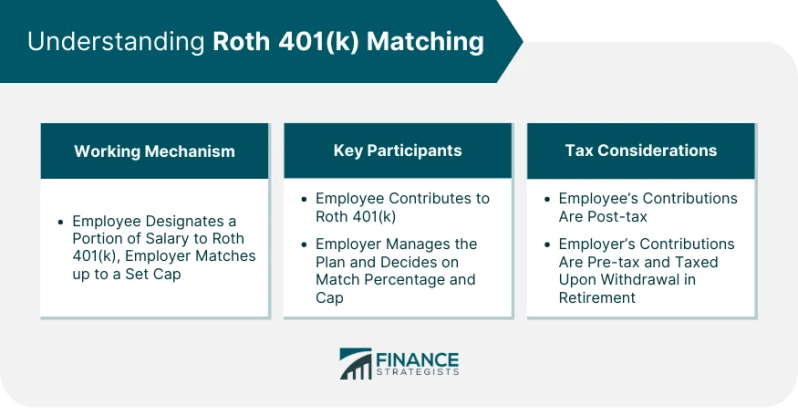
The real advantage lies in tax-free withdrawals. Unlike traditional 401(k)s, where withdrawals are taxed as ordinary income, Roth 401(k) distributions are never subject to federal income tax. This can be a lifesaver in retirement, especially if you anticipate higher tax rates or need to supplement income from other taxable sources. Additionally, Roth 401(k)s don’t have income limits for contributions, unlike Roth IRAs, making them accessible to high earners. However, employer matching contributions (if offered) must be treated as traditional pre-tax contributions unless specified otherwise by the plan.
Key Benefits and Crucial Impact
The Roth 401(k) isn’t just another retirement account—it’s a financial hedge against future uncertainty. With tax rates fluctuating due to policy changes and economic cycles, locking in today’s tax rates on future growth can be a powerful strategy. For example, if you’re in the 24% tax bracket now but expect to be in the 32% or higher bracket in retirement, paying taxes upfront saves you significantly. This is particularly relevant for younger professionals who may see their incomes—and tax brackets—rise over time.
Beyond tax savings, the Roth 401(k) offers flexibility that traditional accounts lack. Since contributions are made with after-tax dollars, you can withdraw them penalty-free at any time (though earnings may still be subject to taxes and penalties if withdrawn early). This feature is invaluable for emergency funds or early retirement scenarios. Moreover, because Roth 401(k)s aren’t subject to required minimum distributions (RMDs) during your lifetime, you can defer taxes indefinitely, passing the account tax-free to heirs. This makes it a cornerstone of estate planning for many families.
— David John Marotta, CFP® and co-author of The 9 Steps to Financial Freedom
"The Roth 401(k) is one of the most underutilized tools in retirement planning. It’s not just about avoiding taxes—it’s about creating a tax-free legacy that can outlast your lifetime."
Major Advantages
- Tax-Free Growth and Withdrawals: Contributions and earnings grow tax-free, and qualified withdrawals are never taxed. This is a rare opportunity to shelter long-term wealth from Uncle Sam.
- No Income Limits: Unlike Roth IRAs, Roth 401(k)s don’t phase out based on income, making them ideal for high earners who exceed IRA contribution thresholds.
- Higher Contribution Limits: You can contribute up to $23,000 (or $30,500 if 50+) in 2024, compared to $7,000 for Roth IRAs, maximizing your tax-advantaged savings.
- Flexible Withdrawals of Contributions: While earnings are locked until age 59½, you can access your contributions (not earnings) penalty-free at any time, offering liquidity in emergencies.
- No RMDs During Your Lifetime: Traditional 401(k)s require withdrawals starting at age 73, but Roth 401(k)s let you defer taxes indefinitely, allowing your investments to compound longer.
Comparative Analysis
Understanding how the Roth 401(k) stacks up against other retirement accounts is critical for optimizing your strategy. Below is a side-by-side comparison of key features:
| Feature | Roth 401(k) | Traditional 401(k) |
|---|---|---|
| Tax Treatment on Contributions | After-tax (no upfront deduction) | Pre-tax (reduces taxable income now) |
| Tax Treatment on Withdrawals | Tax-free if qualified | Taxed as ordinary income |
| Contribution Limits (2024) | $23,000 ($30,500 if 50+) | $23,000 ($30,500 if 50+) |
| Income Limits for Contributions | None | None |
| Required Minimum Distributions (RMDs) | None during your lifetime (must roll over to Roth IRA at 73) | Yes, starting at age 73 |
| Early Withdrawal Penalties | Contributions: Penalty-free. Earnings: 10% penalty (unless exception applies). | 10% penalty on earnings (unless exception applies). |
| Employer Matching Contributions | Typically pre-tax (unless plan specifies Roth matching) | Pre-tax |
While the Roth 401(k) and traditional 401(k) share similar contribution limits, their tax treatments diverge sharply. The Roth’s upfront tax hit is offset by the potential for tax-free growth, making it ideal for those who expect higher future tax rates. Meanwhile, the traditional 401(k) offers immediate tax relief, which can be beneficial if you’re in a high tax bracket now but expect lower rates later. Many financial advisors recommend a hybrid approach, contributing to both to balance flexibility and tax efficiency.
Future Trends and Innovations
The Roth 401(k) is poised to play an even larger role in retirement planning as tax policy continues to evolve. With federal debt levels rising and political debates over tax reform intensifying, the certainty of tax-free growth in a Roth account becomes increasingly valuable. Employers are also likely to expand Roth options, including automatic enrollment defaults and Roth matching contributions, which could further boost participation. These innovations would mirror the success of Roth IRAs, where automatic enrollment has driven record adoption rates.
Another trend to watch is the integration of Roth accounts with mega backdoor Roth strategies. High earners who max out their 401(k) and IRA contributions can use after-tax contributions to their 401(k) to fund a Roth IRA, effectively bypassing income limits. As more employers allow after-tax contributions, this strategy could become mainstream, turning the Roth 401(k) into a cornerstone of advanced tax planning. Additionally, the rise of fintech and robo-advisors may simplify the management of Roth 401(k)s, making them more accessible to younger investors who prioritize automation and passive growth.

Conclusion
The Roth 401(k) is more than a retirement account—it’s a financial tool designed to adapt to an uncertain future. By paying taxes today, you lock in current rates and eliminate the risk of higher taxes tomorrow. This isn’t just about deferring taxes; it’s about creating a tax-free asset that can outlast your lifetime and be passed to heirs without penalty. For high earners, young professionals, and anyone who values tax efficiency, the Roth 401(k) is a non-negotiable component of a robust retirement strategy.
Yet, its value isn’t universal. If you’re in a low tax bracket now and expect to stay there, a traditional 401(k) might make more sense. The key is to evaluate your current and projected tax situation, contribution capacity, and long-term goals. Consulting a tax advisor or financial planner can help tailor the Roth 401(k) to your unique circumstances. In an era of volatile tax laws and economic uncertainty, the Roth 401(k) offers a rare blend of security and flexibility—making it one of the most powerful tools in modern retirement planning.
Comprehensive FAQs
Q: Can I contribute to both a Roth 401(k) and a traditional 401(k) in the same year?
A: Yes. Many employers allow you to split your contributions between Roth and traditional 401(k) accounts. This strategy, known as “tax diversification,” can help balance your tax burden in retirement. For example, you might contribute more to the Roth if you expect higher taxes later or to the traditional 401(k) if you’re in a high tax bracket now.
Q: What happens to my Roth 401(k) if I leave my job?
A: You have several options: leave the funds in the plan (if allowed), roll them into an IRA (converting to a Roth IRA if desired), or cash them out (though this may trigger taxes and penalties on earnings). Rolling into a Roth IRA is often the best choice, as it maintains tax-free growth and allows for easier management. If your former employer’s plan doesn’t offer Roth options, a rollover to a Roth IRA may also help consolidate accounts.
Q: Are Roth 401(k) contributions subject to payroll taxes?
A: No. Roth 401(k) contributions are made with after-tax dollars, so they’re not subject to federal income tax, Social Security tax, or Medicare tax. However, employer matching contributions (if pre-tax) are subject to payroll taxes. This distinction is why some plans offer “Roth matching,” where employer contributions are also made on an after-tax basis—a rare but valuable perk.
Q: Can I withdraw contributions (not earnings) from my Roth 401(k) without penalty?
A: Yes. Unlike earnings, which are locked until age 59½ (or another exception applies), your contributions can be withdrawn at any time, penalty-free. This is because you’ve already paid taxes on them. However, withdrawing earnings early typically triggers a 10% penalty unless you qualify for an exception (e.g., disability, first-time home purchase, or qualified education expenses). Always check with your plan administrator for specifics.
Q: What’s the difference between a Roth 401(k) and a Roth IRA?
A: The primary differences lie in contribution limits, income restrictions, and employer involvement. Roth 401(k)s allow higher contributions ($23,000 vs. $7,000 in 2024) and don’t have income limits, while Roth IRAs phase out at certain income levels. Additionally, Roth 401(k)s don’t have RMDs during your lifetime (though you must roll them over to a Roth IRA by age 73), whereas Roth IRAs do. Many high earners use both: maxing out their 401(k) and supplementing with a backdoor Roth IRA.
Q: Do Roth 401(k) withdrawals count toward my required minimum distributions (RMDs) if I roll them into a Roth IRA?
A: No. When you roll a Roth 401(k) into a Roth IRA, the funds are no longer subject to RMDs during your lifetime. However, the rollover itself doesn’t eliminate RMDs for the portion of your traditional 401(k) that remains in the plan. Once fully rolled into a Roth IRA, you can leave the funds invested indefinitely, allowing tax-free growth for your heirs. This is a key reason why many retirees convert their Roth 401(k)s to Roth IRAs.
Q: Can my employer offer a Roth 401(k) if they don’t already have one?
A: Yes, but it requires plan amendments. Employers must update their 401(k) plan documents to include Roth provisions, which can be costly and time-consuming. Some may choose to adopt a “Roth-only” 401(k) or offer it as an optional feature alongside traditional accounts. If your employer hasn’t offered it yet, you can advocate for it—especially if you’re a high earner or part of a younger workforce that values tax-free growth.
Q: Are there any states that tax Roth 401(k) withdrawals?
A: It depends on the state. Some states, like California and New York, don’t tax Roth withdrawals because they don’t tax federal benefits. Others, like Texas (which has no state income tax) or Florida, also don’t impose additional taxes. However, states like New Jersey and Pennsylvania tax withdrawals from traditional 401(k)s but may not tax Roth withdrawals. Always check your state’s tax laws, as they can vary significantly. A financial advisor familiar with your state’s regulations can provide clarity.
Leave a Comment
Comments are moderated before appearing. The data you submit is processed according to the Privacy Policy of Neip.